
Upper School at Wheeler
Students in Wheeler’s Upper School of Grades 9-12 embrace academic challenges, take risks, work hard and find joy while doing all of the above! Our students are high achievers who know how to collaborate. They are confident public speakers who are also good listeners. They know relationships matter while they are finding their own voice. Each is prepared to take the next steps to college and life.
Our Philosophy
It is our belief that giving students (that’s you!) the opportunities to take risks, embrace challenges, and find great joy in the learning process is as important as what each student learns. We hope that you, with the support of teachers who are experts in their fields, will not only graduate with a strong foundation of skills for college but that you will develop interests that will sustain you throughout your life. You can take a traditional path through a rigorous curriculum that is expansive and inspired. You can also take a road less traveled through our Design Shop seminars and follow a studio approach to learning with project teams and critiques that mirror the world of innovative design thinking.
Our Program
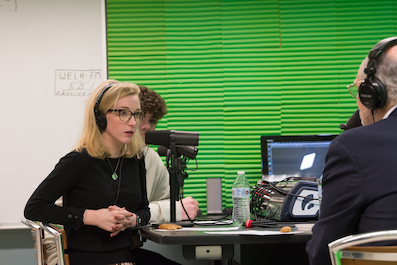
The Wheeler Upper School is academically rigorous, artistically rich and athletically competitive. Curricular disciplines are not so much crossed as melded — 11th graders in a short story elective create a three-part fictional podcast in Wheeler’s Digital Production Studio, for example. An intentional curriculum focuses on diversity, equity and inclusion, health and wellness, metacognition and social-emotional learning. We build the ‘muscles’ of empathy and resilience. We share, listen and laugh together. We disagree with respect and we learn with purpose.
Our Co-Curriculum
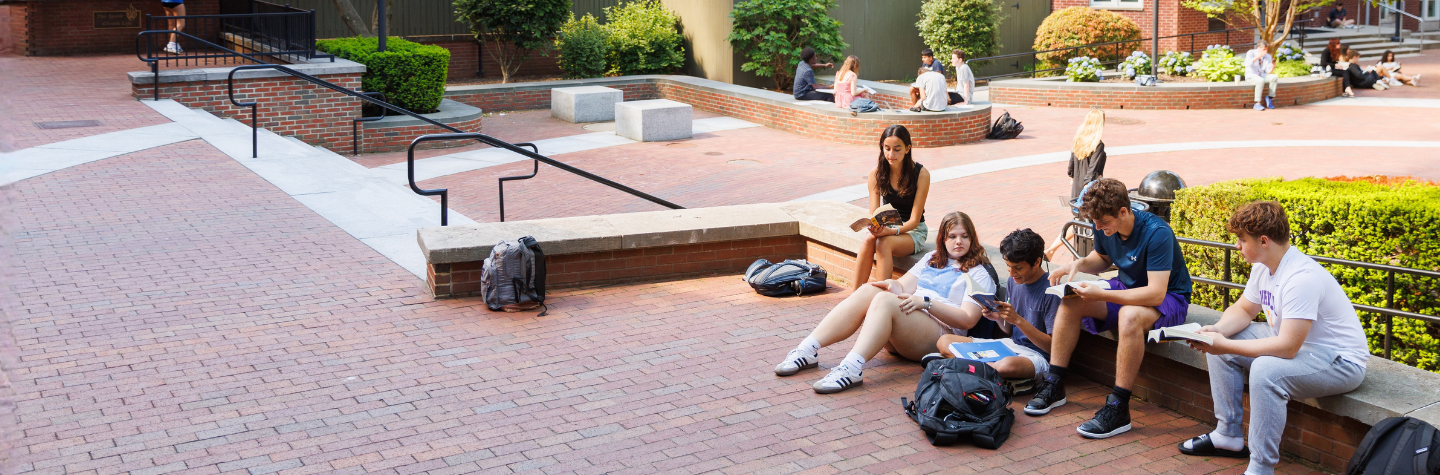
Upper School students participate in a variety of co-curricular experiences. Through Wheeler’s signature Aerie Approach, we connect students with passionate interests (from quantum physics to learning Turkish) with academic mentors from the surrounding colleges and the Providence community. Community Service Learning (CSL) is an important part of the Upper School experience at Wheeler and a graduation requirement. The program is designed to broaden horizons, foster individual responsibility, and strengthen leadership skills through a commitment to service. Through structured reflection, students assess the impact of their service on the organization, the community it serves, and themselves. Opportunities exist to assume leadership roles as members of clubs, class officers, and participants on one of our many academic and athletic teams.
Contact Neeltje Henneman (neeltjehenneman@wheelerschool.org), Upper School Head, for more information.
Upper School Administration
See Our Stories

We’re dancing our way into the weekend, courtesy of the Upper School’s “Foundation of DJ’ing” class.
“In this Aerie Enrichment, we cover the essentials of DJ’ing,” says faculty member David Schiano P’26 who, in addition to serving as director of operations for Wheeler’s radio station, WELH 88.1FM, has over three decades of professional DJ experience for events, nightclubs, and weddings.
During this course, Mr. Schiano shows students the layout of digital controllers and teaches them how to count beats, bars, and phrases so they know how and when to transition between tracks, to match the tempos of two different songs, and to align their beats manually or using software tools.
The Foundation of DJ’ing class was a former enrichment that Mr. Schiano was inspired to bring back this year when he saw student William G. ’27 sitting in the cafeteria one day, spinning music using a small controller. “I told him I’ve been a DJ forever, we started talking, and we made it into an official Thursday appointment where I could help him use different equipment and keep advancing.”
From there, this one-on-one DJ booth became a bit more crowded when Mr. Schiano and William thought it would be fun to open the lessons to any interested Upper School students through Aerie.
On the day we stopped by, Mr. Schiano was working with William and William’s friend and fellow senior, Hilario L. ’27.
“I love DJing,” William says, one hand on a turntable. “Being able to mix two songs together and keep that energy and that vibe, that really resonates with me.”
Hilario describes himself as William’s apprentice. “He showed me the ropes, and I’ve always loved music ever since I can remember. For me, being able to create remixes on the fly is so nice, and I love listening to the drops.
“And it’s always great to get feedback from someone in the industry,” Hilario adds, turning towards Mr. Schiano.
William agrees. “I don’t think I’d be where I am right now without Mr. Schiano’s help.”
“That’s a good remix,” Mr. Schiano responds right on cue (or tempo), his head nodding along to William’s music.
Oct 9


Fourth-grade artists have been working on a shoe-perb drawing unit with Lower School Art Teacher Adam Ferbert. First, they practiced contour lines, learned to draw hidden objects by touch alone, and sketched objects from multiple viewpoints. After experimenting with pure contour and continuous line drawings of their hands, the students moved on to a simple still life using something they all brought to class: their shoes! 👟✏️
“The art room grew really quiet as the students practiced drawing from observation, focusing on capturing all the little details, from stitching to texture,” says Mr. Adam. “It was great to watch these young artists become so wrapped up in drawing an object they see every day but might never have taken the time to really look at. Sometimes, slowing down and looking closely can help us see something familiar in a whole new way!”
Next, the fourth-graders will use copies of their drawings to experiment with cross-hatching in pen and add watercolor to their designs. 🎨
Oct 9

“It was a long haul,” Head of Upper School Neeltje Henneman says on the latest episode of The This Week at Wheeler Podcast – and no, she isn’t talking about this being her last school year at Wheeler (at least just yet in our interview). Rather, she’s reflecting on her beloved Mets and their disappointing season. Still, Ms. Henneman says, “There’s always next year.”
Once we move beyond baseball, though, she’s happy to talk about her time at Wheeler. From her very first day to today, 19 years later, it’s always been about the Upper School community. “A school is only as good as its teachers and its students,” she says. “The kids and the adults are the things I’m going to miss the very most.
“The high school kids, I’ll say the same things about them that I would say about the faculty: They’re smart. They’re curious. They’re funny. They’re annoying. They’re all the things. That’s where the joy is in school for sure. It’s the people.”
“It’s also the families,” she continues. “Collaborating with families has been a big part of my job here. To participate in the shared work of shepherding these children from 14 to 18 is a privilege, and it’s one that we don’t take lightly. We couldn’t do it without support from home.
“There’s a generosity of spirit” at Wheeler, she adds with appreciation. “I do feel very lucky.”
We feel very lucky that Neeltje has been our head of upper school for nearly two decades. You can listen to the rest of our conversation at bit.ly/ms-henneman.
And while she won’t be at Wheeler next fall, you can be sure to catch Ms. Henneman a year from now as she watches her Mets play October baseball.
Oct 8

Look who we spotted in the art studio! 🦁🐮🎨
If you want to see more of what’s happening at Wheeler, join us for our K-12 Open House on Oct. 17 or our Nursery-PreK Open House on Nov. 14 @thenestatwheeler.
You’ll have the chance to meet our faculty, students, staff, and current families and experience some of what makes Wheeler such a special place to learn and grow.
Visit wheelerschool.org/events to learn more and register, or click the link in our bio.
We can’t wait to see you!💜💛
Oct 8
