Commencement 2026: Speech by Former Hamilton School Director Jon Green P’03, P’06, P’11
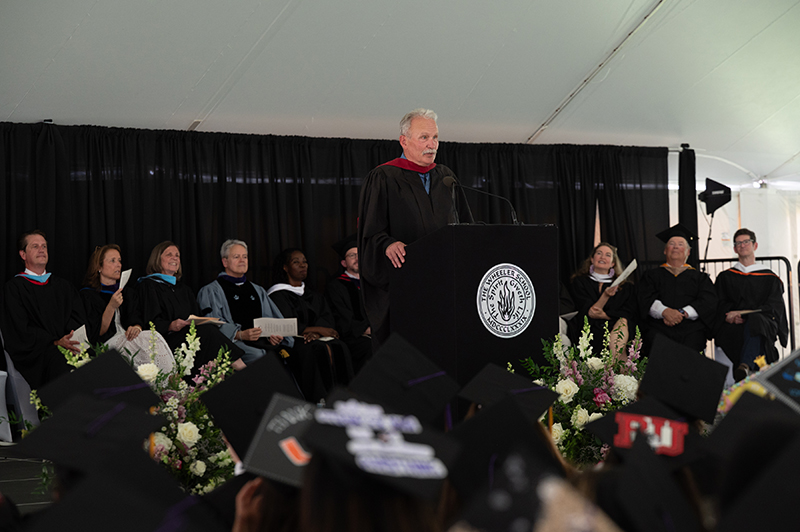
Good morning, Wheeler Community.
What a BIG day. So happy to be here… and slightly terrifying at the same time.
When I was in first grade I had a terrible stutter. I can still remember struggling to say certain sounds such as, “where” “what” “how”, and “why”.
Needless to say I did not ask many questions in first grade.
And yet here I am — voluntarily speaking in front of hundreds of people.
I am truly happy to be here today at Wheeler’s 137th Commencement.
In 1938, while our country was still in the grip of the Great Depression, Harvard University began a study to answer a simple question:
What makes a good life?
For nearly 90 years, researchers followed hundreds of people, beginning with students 2 years older than most of you seniors — tracking their health, work, and relationships in the longest-running study of adult development ever conducted.
They wanted to know: Who ends up happy… and why?
And here’s what they found. It wasn’t wealth. It wasn’t fame. It wasn’t even professional success.
The clearest finding was this: Good relationships with other humans don’t just make us happier — they make us healthier, too. I’ll come back to this.
But first and most important—Congratulations! Congratulations to our Wheeler seniors. And, to your parents, grandparents, families, teachers, mentors, and friends. What a HUGE accomplishment!
Seniors, you will remember this day for the rest of your life. For many of you, this place has been home for a long time. This is where you grew up — with people who know you, who challenged you, who supported you. People who showed up for you.
Today, you close one chapter and begin another. I suppose that is why we call this “Commencement”. Commencing the next adventure.
But for now, let’s just take a moment. Look around. This is a good moment. Slow it down. Breathe. Just appreciate it.
It’s such an honor to be here with you — some of you I’ve known since you were six or seven years old and I was, well, a bit younger, too. I’ve had the privilege of watching you grow into the people sitting here today.
Thank you, Mr. Anderson, for inviting me to celebrate this event with these fine people.
Some years ago, there was a 1st-grader here at Wheeler. I’ll call him Teddy.
Teddy had a lot going for him — infectious energy, a winning smile, sweet and funny, the kind of kid everyone noticed and loved. But he was struggling to learn how to read.
His parents were concerned. His teachers were paying attention. Eventually, it was recommended that he be evaluated. And yes, surprise, surprise, it turned out he had dyslexia.
Maybe he needed to transfer to Hamilton a program designed for children such as Teddy. Transferring a child out of 1st grade to a “special program” can be a very big deal for a child and his/her family.
So, Teddy visited the 1st grade at Hamilton. His parents met with Hamilton Admission Director Jeanette Epstein and me. Everyone was trying to figure out the details. Was this the right move? Would it be too disruptive midyear? What would it mean for the family? The decision felt enormous. There were many hurdles to overcome. This will take time to decide.
The next morning, I was sitting in the Green chair in the Whitaker Building at Hamilton reading the newspaper when, unexpectedly, Teddy came bursting through the door. Clearly, he was on a mission.
“Good morning, Mr. Green,” he said, barely slowing down. Then he looked at me and said, “Don’t worry. Everything is all set.
I’m going to my new class. I told my teacher and I’ll see my old class at lunch.”
And then… he just kept walking.
I dropped my newspaper and tried to catch up to him, following him into the classroom. The teacher looked at me. I looked at her. He was already in the classroom. She paused for half a second and said, “We have a desk right here for you.”
And THAT was THAT. And I’m standing there holding my newspaper like a bewildered substitute teacher.
Of course, the adults caught up the next day. Paperwork was completed. Decisions were formalized. But Teddy already knew.
So what was my problem? Isn’t that exactly what we were trying to create when Hamilton was started? A place where a child feels like they belong. A place where they can walk into a room and believe, this is where I’m supposed to be. And, THAT is what community feels like.
And here’s the thing — you don’t always notice it while you’re in it. It’s not something you can point to on a map. But you feel it. Community. Hopefully, you all have felt it here.
And, now, back to that Harvard study. After nearly 90 years of research, the conclusion was clear: the single strongest predictor of happiness and long-term health is the quality of our relationships. We need each other. At 18. At seven. At 74. At every age.
And in a world where it’s easy to confuse connection with followers, likes, and emojis— the research is also clear: digital connection alone is not enough.
Real relationships matter. Showing up matters. Being known — and knowing others — and helping others feel known, matters.
So, maybe this moment isn’t about leaving this community behind. Maybe it’s about taking what you’ve learned here — about friendship, about trust, about showing up — and building it again, wherever you go next.
Because here’s what I know after 30 years of watching students move through this place: You already know how to do this. You learned it here. You learned it when a teacher stayed after class for you. When a friend sat next to you during a hard moment. When a coach believed in you before you believed in yourself. And…when you did those same things for someone else.
You didn’t just receive community. You helped build it. That’s the skill. That’s the advantage. That’s the thing to carry forward.
The researchers spent nearly 90 years searching for the secret to a good life. Teddy figured it out in first grade.
Walk into the room. Find your desk. And, help someone else find theirs.
So, Class of 2026 — Go find your people. Be someone’s person. Build your communities with intention and generosity. Because a good life isn’t something you arrive at someday. It’s something you practice — day after day — in the way you care for the people around you.
It has been one of the great honors of my life to be part of this community, and to watch so many of you grow into who you are today. Now go. Your next community is waiting.